Knowledge Capture
An AI-assisted interview tool for capturing tribal knowledge and turning it into structured, reusable knowledge.

Internship Project at Accenture Industrial X · Industrial Design
Overview
How might expert interviews turn tribal knowledge into reusable knowledge?
Background
Started as an early-stage AI Interview Tool demo in Accenture's GenAI Studio. The challenge was to redesign it into a more coherent product for real enterprise use.
Challenge
Capture the tribal knowledge behind repair work and turn it into structured, reusable procedures.
Constraints
We were working with an early-stage product, limited access to end users, and existing technical and business constraints.
The Original Demo
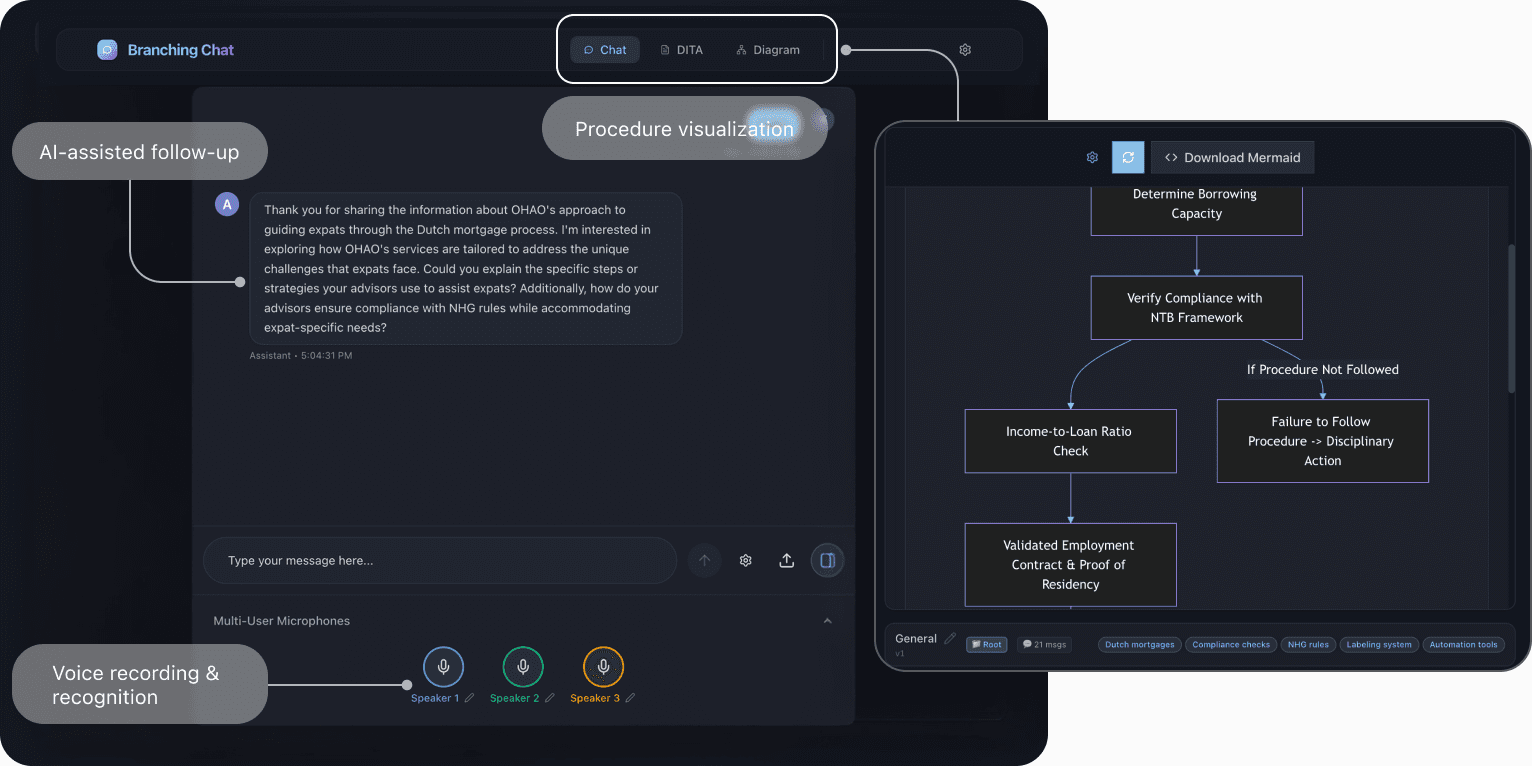
Interviewing was competing with knowledge management
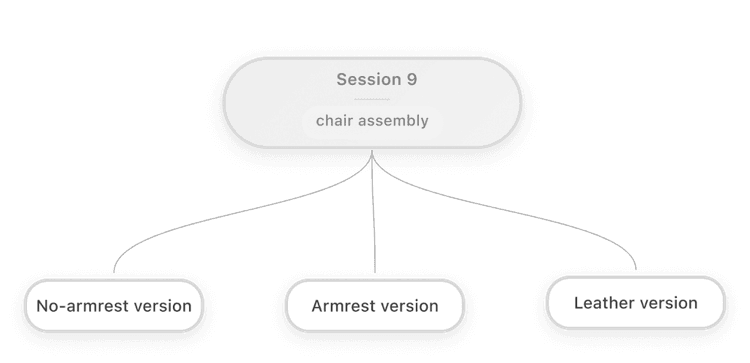
Branching as the core mechanism
Interviews were captured as branches that later became structured knowledge.
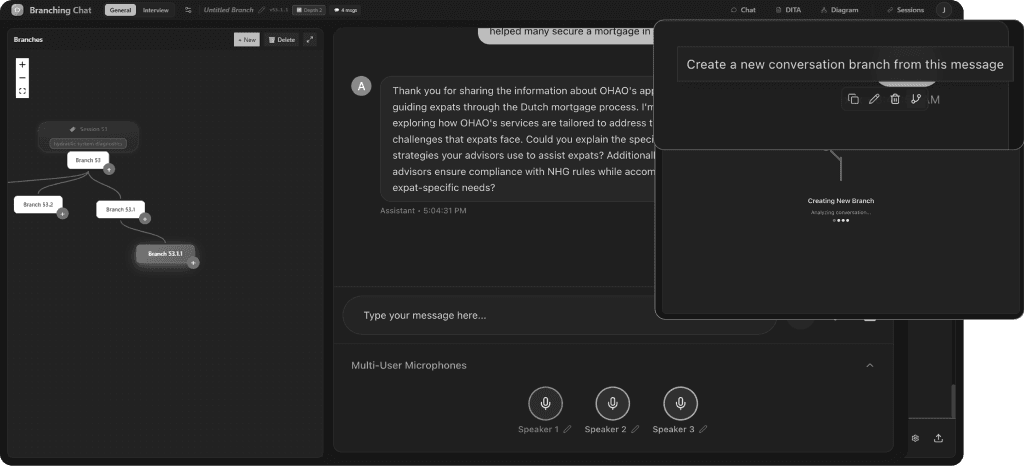
During Interview
Interviewers had to create and switch branches while maintaining the conversation.
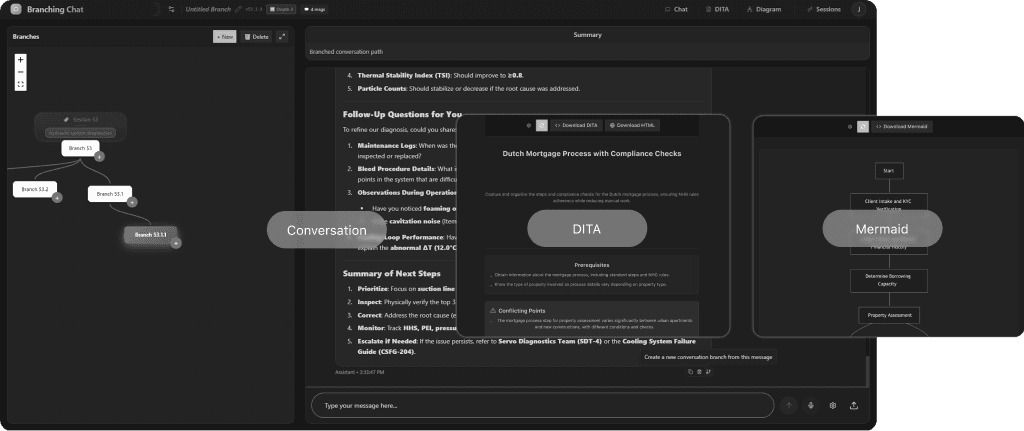
After Interview
The same branching model was then used to review and structure captured knowledge.
The Turning Point
How we got there
Imagine we're in the factory.
One of us is interviewing a repair expert using the original demo.
The expert changes topic. A new procedure comes up.
Interviewer's POV:
“Where do we create a branch?”
“When do we organize it?”
Do we stop listening to the expert to manage the path?
The problem wasn't just usability. The interviewer's attention was being split between the expert and the system.
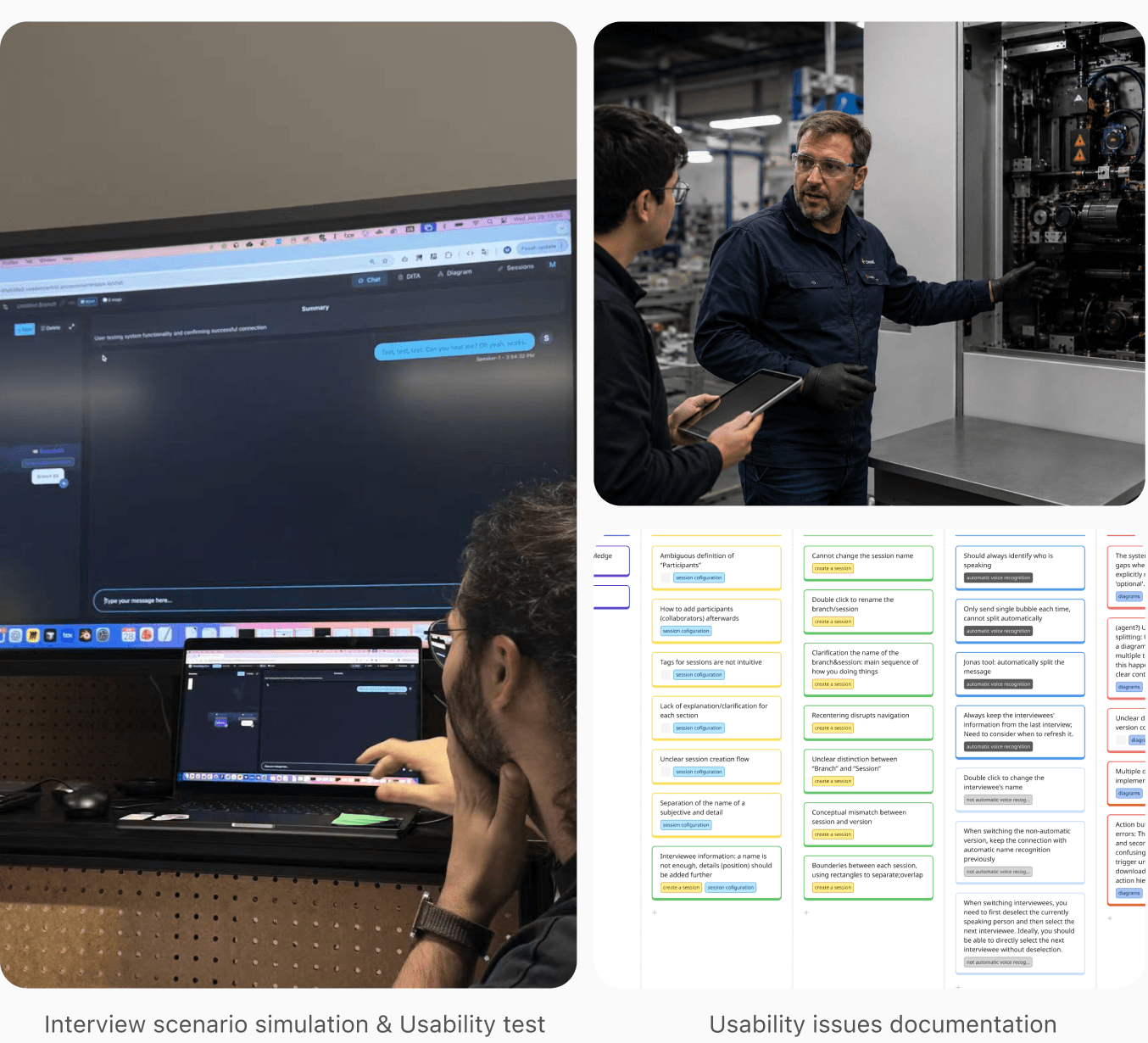
This reframed the question:
How might we support a focused interview while capturing reliable, reusable expert knowledge?
Solution: the North Star Experience
Knowledge Capture
An AI-assisted platform for capturing tribal knowledge and turning it into reusable procedures.
It supports expert interviews, procedure review, and knowledge management across the product.
01. Interview expert
- AI-assisted interview guidance
- Human-controlled procedure boundaries
- In-session knowledge validation
02. Knowledge hand-off
- Review and refine captured repair procedures
- Place and connect them in the knowledge graph with AI support
03. Keep knowledge evolving in branches
- Keep branches as the core structure
- Connect related knowledge across procedures and projects
- Refactor and reorganize knowledge as needs evolve
My Contribution
My Role & Ownership
With team
(11.2025 - 01.2026)- Research & workflow reframing
- Defined the split between Interview Mode and Knowledge Management
- Explored the early North Star direction

Independently
- Extended the concept into an end-to-end experience
- Redesigned Interview Mode, hand-off, and Knowledge Graph
- Built the final UI and interactive prototype
Research
Understanding the repair knowledge landscape
Existing knowledge practices
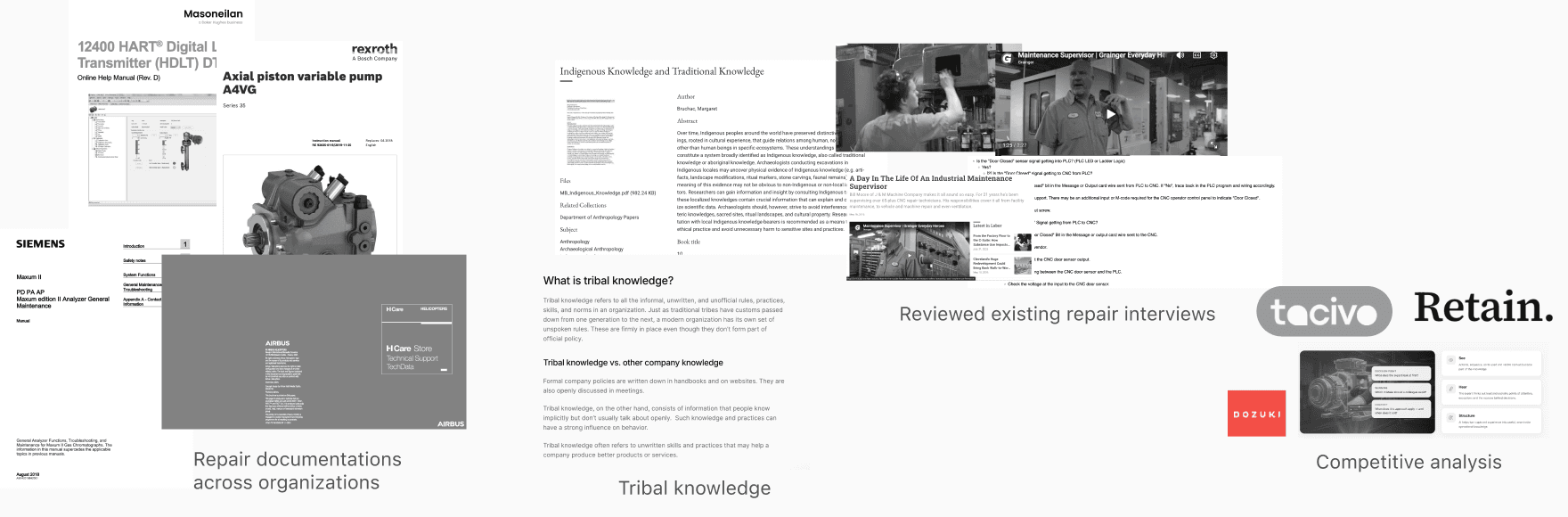
Knowledge structures vary
System needs to stay flexible across organizations
Formal documentation can miss tacit context
Capture judgment, exceptions, and troubleshooting
Interview support is less emphasized
Existing tools tend to emphasize knowledge organization
Understanding how tribal knowledge surfaces in interviews
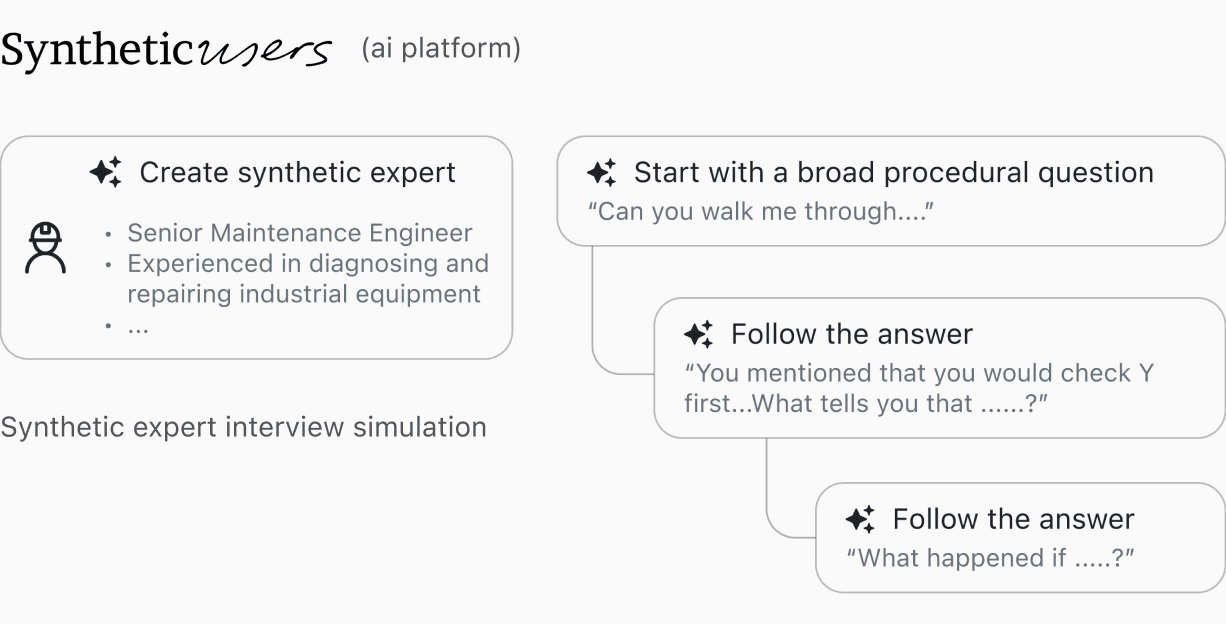
I used a synthetic expert simulation to experience a realistic interview scenario.
The value is in the follow-up
Follow-ups reveal exceptions, judgment, and unexpected details.
Redesign Goals & Strategy
Balancing user needs with enterprise scalability
The redesign needed to work at two levels: reduce cognitive load during interviews, while remaining adaptable across different organizational knowledge systems.
01
Separate interviewing from organizing
Keep the interview focused on the expert.
02
Support deeper tribal knowledge capture
Use contextual follow-ups to uncover exceptions and judgment.
03
Keep knowledge flexible and evolving
Allow captured knowledge to be edited and reorganized.
Workflow Architecture
Separate interviewing from knowledge organization
I explored two ways to separate the activities.
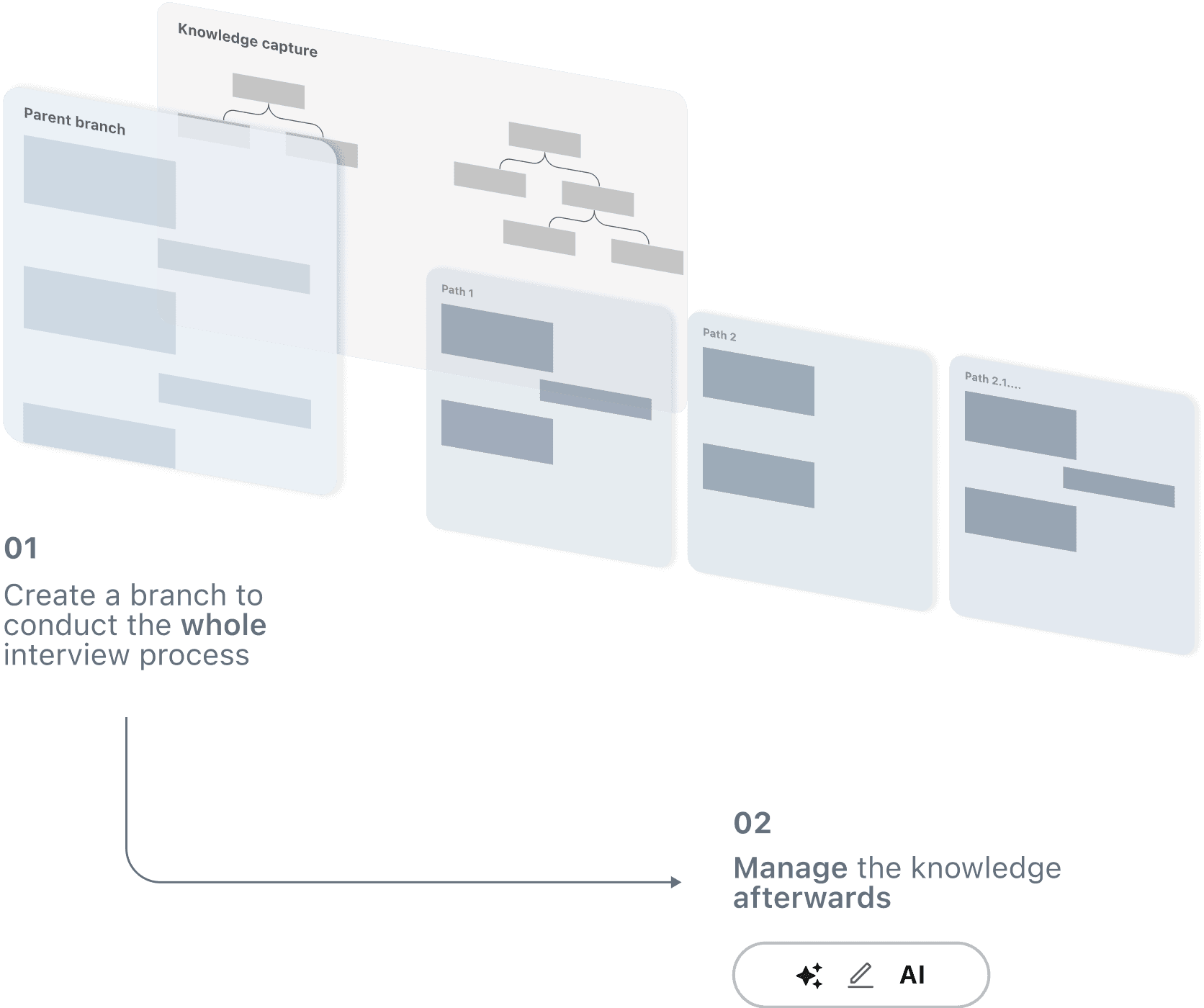
01. Preserve the existing structure but split the process
Smaller structural change
Keeps the existing branching model
The interview is still tied to the knowledge structure
Blurred workflow
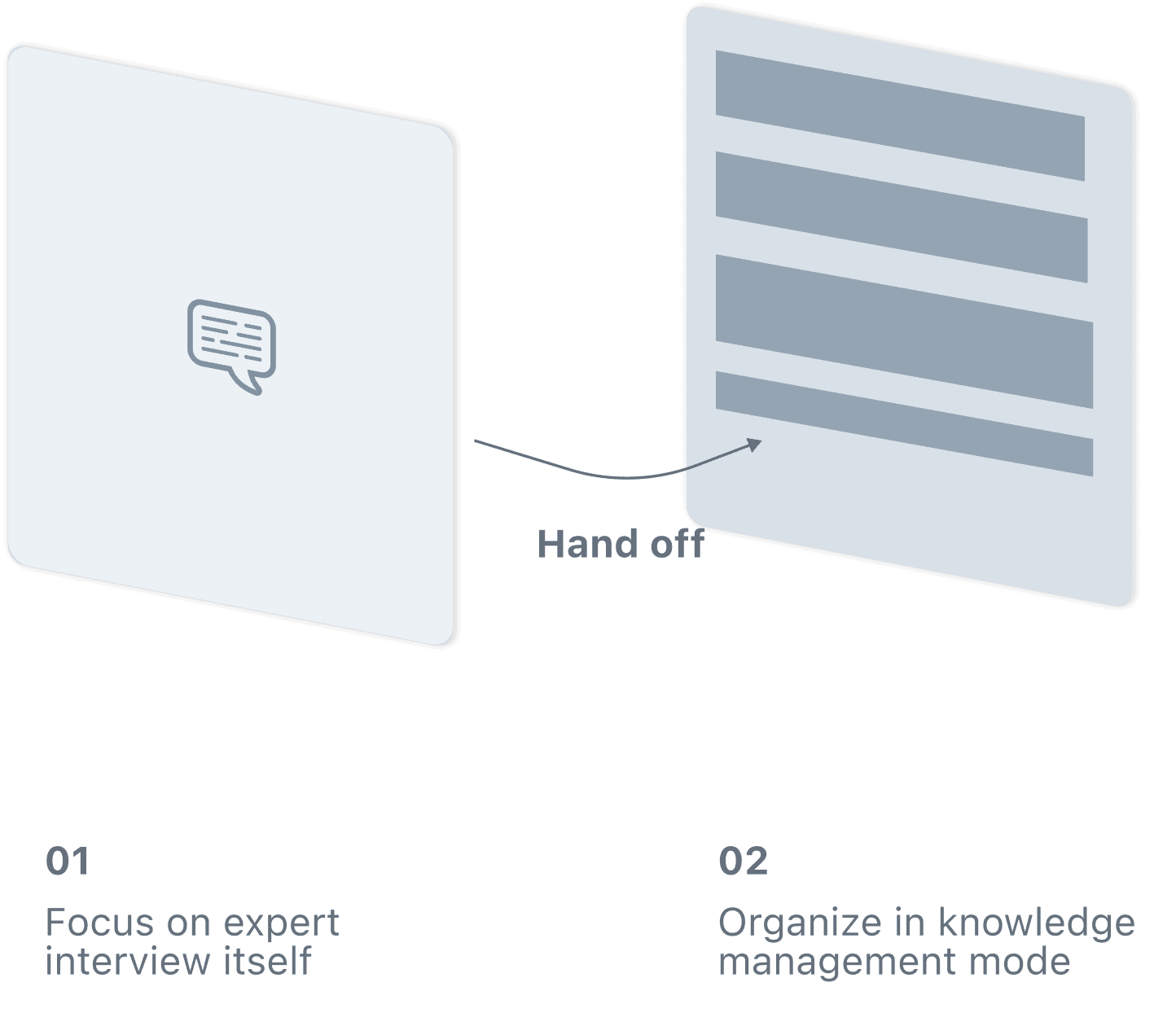
02. Restructure around two modes

Lower cognitive load during interviews
Clearer separation of activities
Requires a new information model
The constraint changed the role of branching
“Branching had to remain a core product proposition.”
Trade-off
We moved away from fully separating the new architecture from the existing branching model, while preserving a dedicated interview workflow. Branching shifted from guiding the conversation to organizing captured knowledge.
Defining the new information architecture
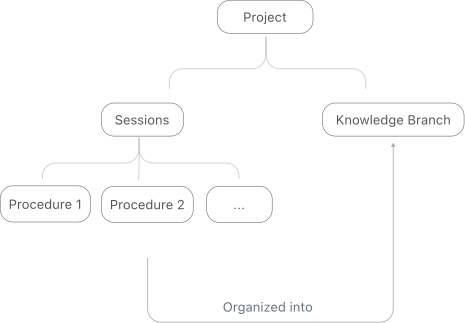
- Project provides shared context
- Session represents an interview
- Procedure represents captured repair knowledge
- Knowledge Branch organizes related procedures
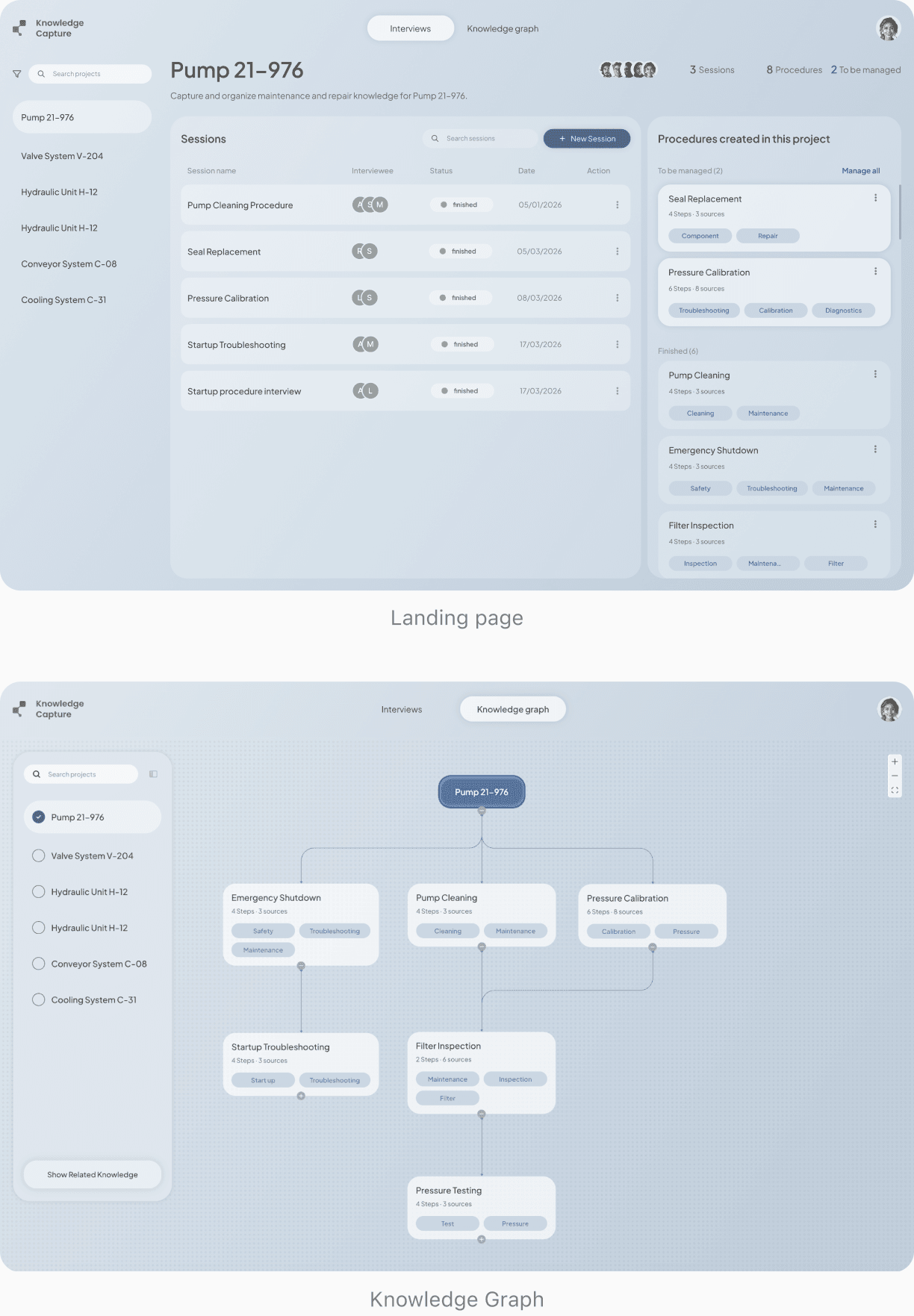
Interview Experience
Turn live conversations into structured knowledge
Together with team, I focused on how the interview experience could surface deeper tribal knowledge through follow-ups, lightweight structuring, and validation.
Starting point
The original demo already had the building blocks for interviewing.
The challenge was defining how they should work together to support a focused interview experience.
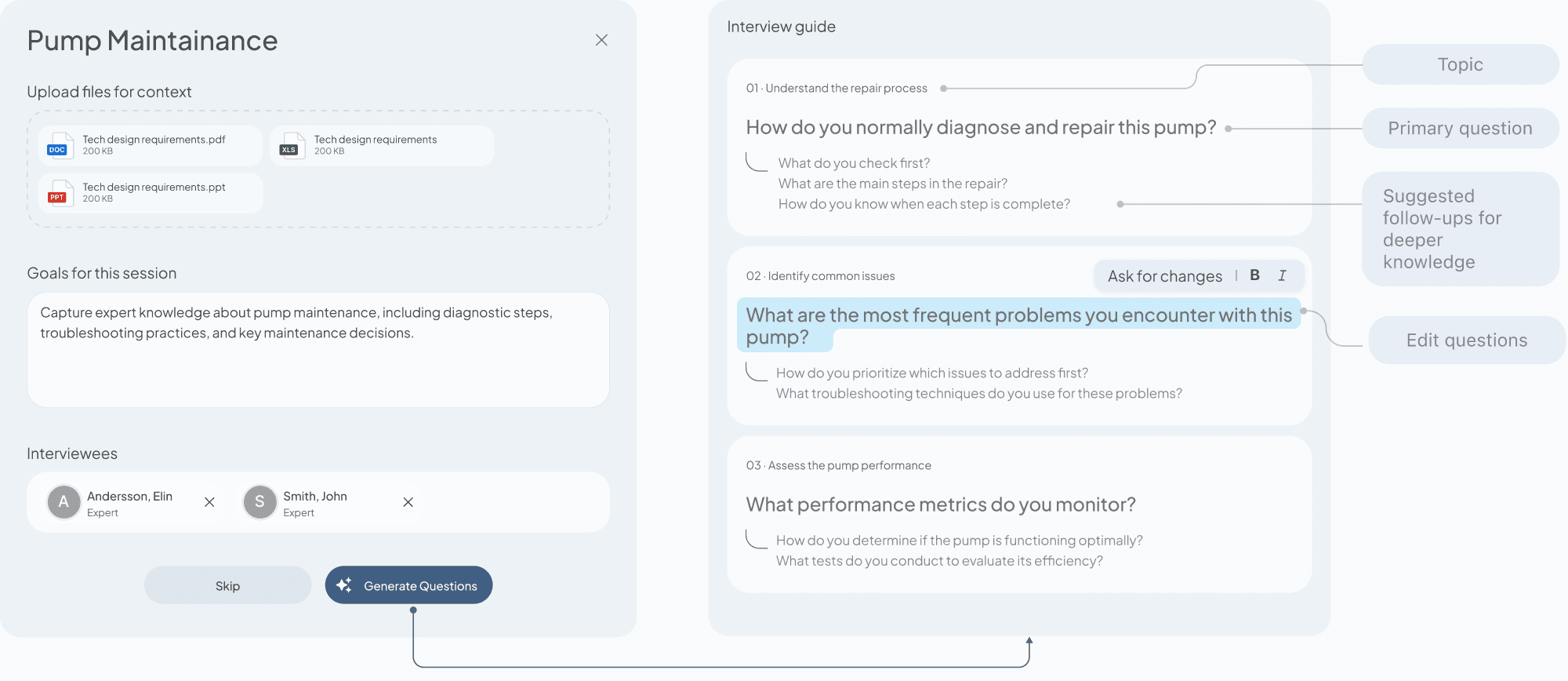
How might we better support the capture of tribal knowledge?
Separated stable guidance from live support
Preparation context could shape the interview beforehand, while the generated guide remained as a stable reference during the conversation.
Separated live support into a dedicated panel
I explored where live AI assistance should appear when the conversation moved beyond the prepared guide.
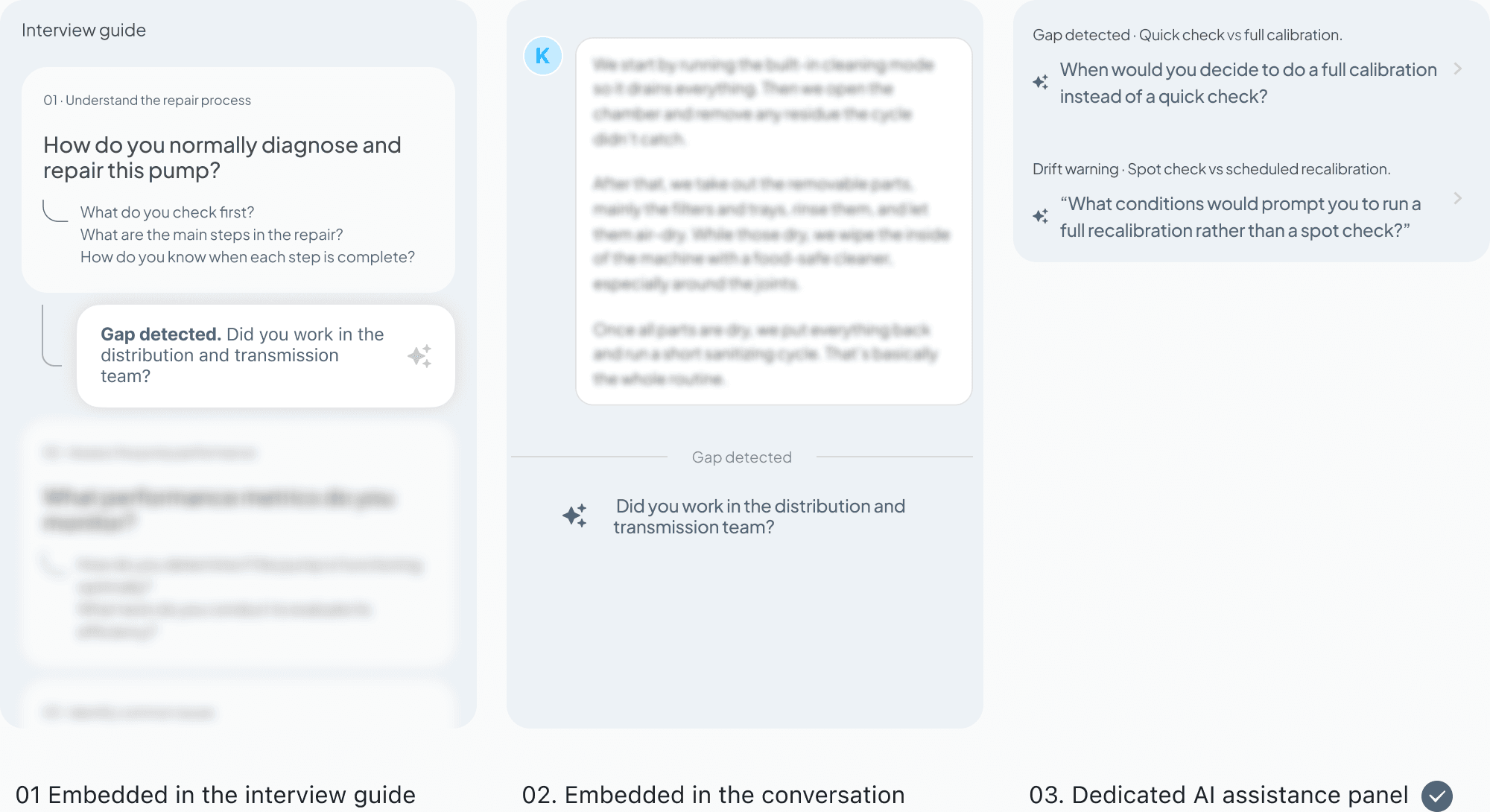
How might we turn a live interview into structured and reliable procedures?
Without branches guiding the interview, procedure boundaries had to be defined differently.
Our simulation showed that AI could detect topic shifts, but not reliably infer the interviewer's intent.
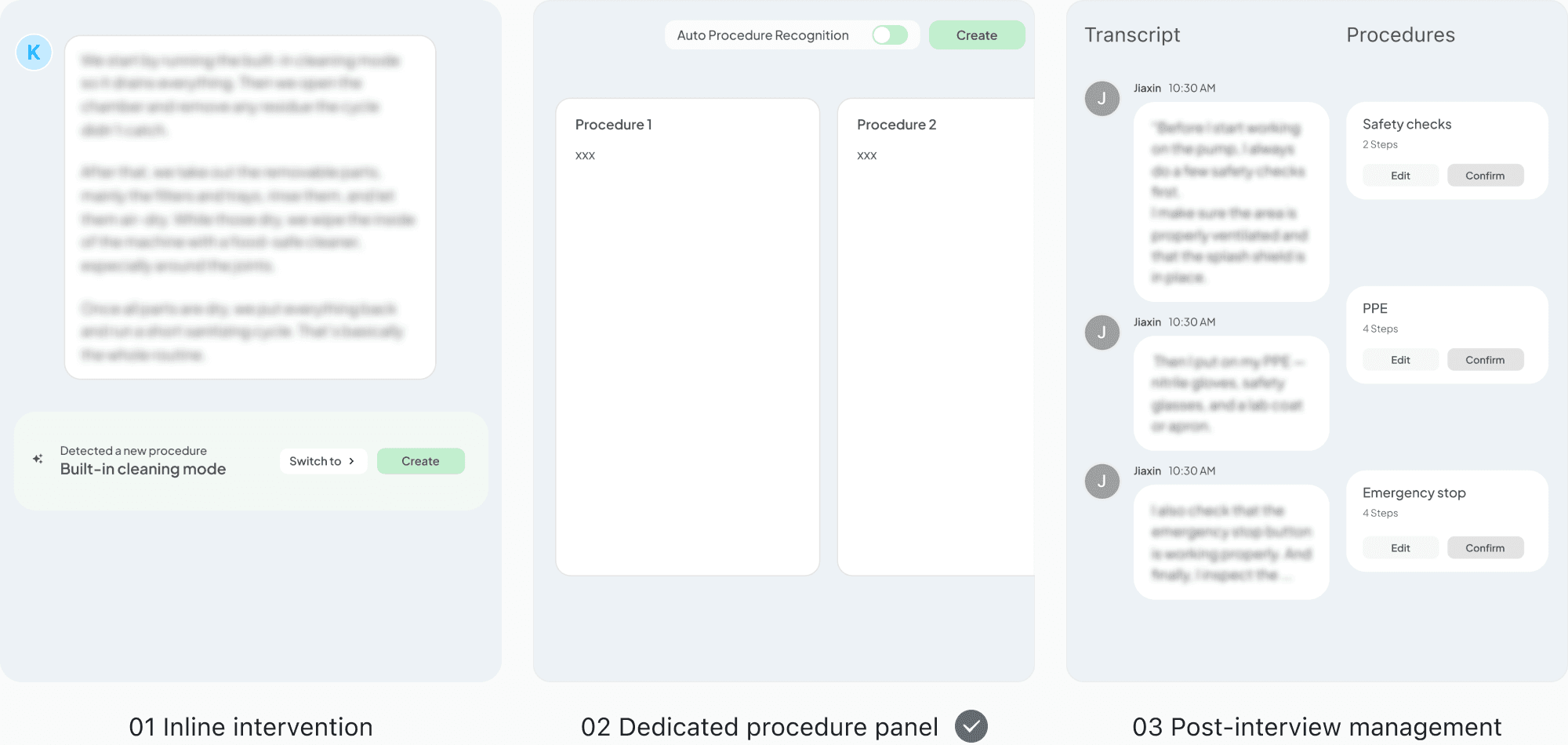
The challenge was to keep boundary decisions with the interviewer without bringing cognitive load back into the conversation.
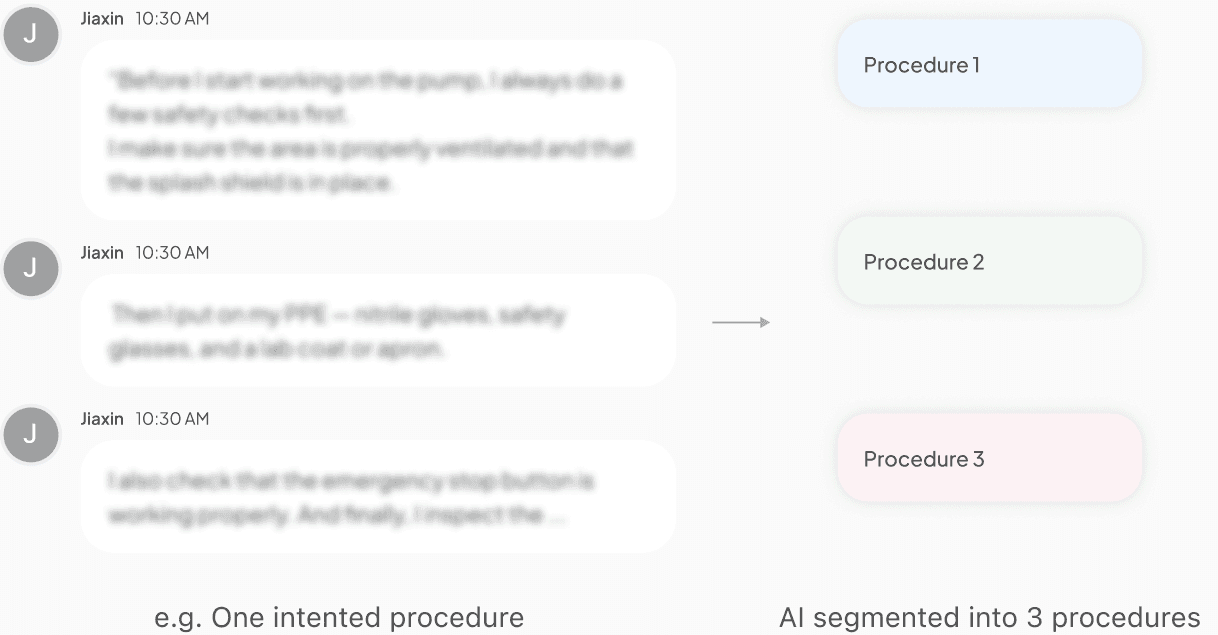
Exploring the level of AI involvement
Make captured knowledge structured and reviewable
I reorganized captured procedures into a clearer hierarchy, while keeping every part editable for expert review.
Before
Existing representations were rich, but harder to review during interviews
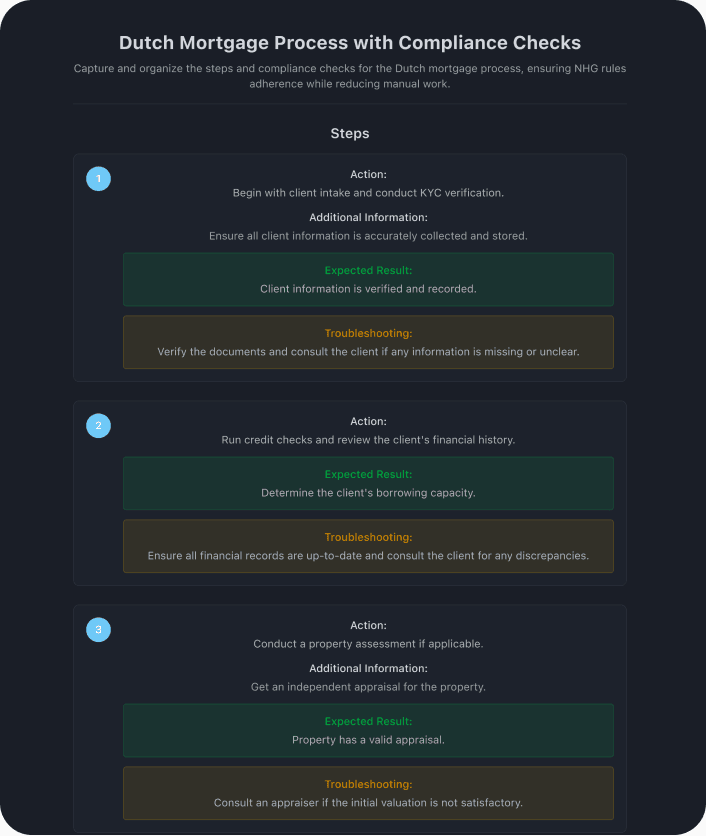
After
AI can suggest procedure boundaries during the interview. Interviewers can create, switch, or correct procedures at any time.
How might we bring the interview support system together?
(Independent continuation)
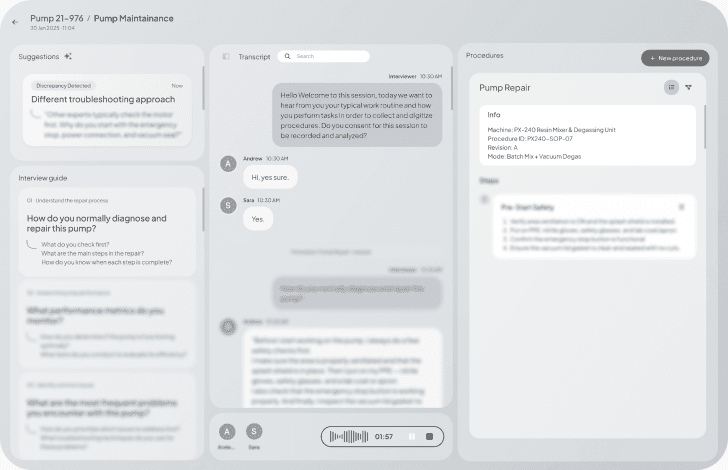
V1 all major panels stayed
Information-rich, but attention-heavy
V2 Prioritize the interview workspace
I kept the primary support panels visible, while collapsing the transcript into an on-demand view to reduce visual competition and keep attention on the live interview.
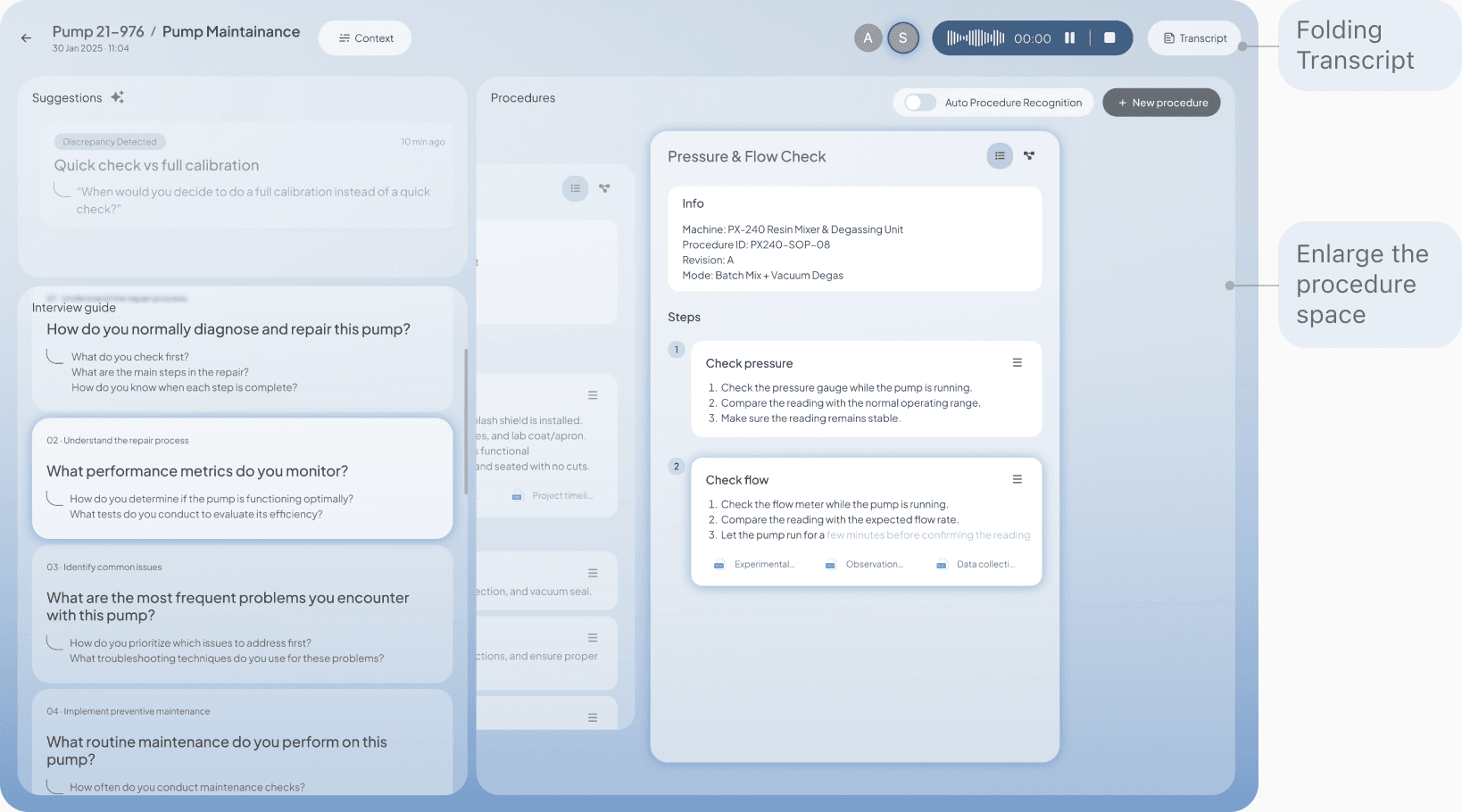
The final interview experience
Prepare
Build context & generate interview guidance
Live conversation
Capture knowledge through interview
Validation and review
Review, refine, and confirm captured procedures before handoff.
Knowledge Organization (Independent Continuation)
Make knowledge relationships explicit and editable
I explored how the original branching model could evolve into a more flexible knowledge workspace without losing its structural clarity.
Starting point
The original tool used branching trees to organize captured knowledge.
After separating the modes, branches were no longer conversation paths, but a way to organize captured knowledge.
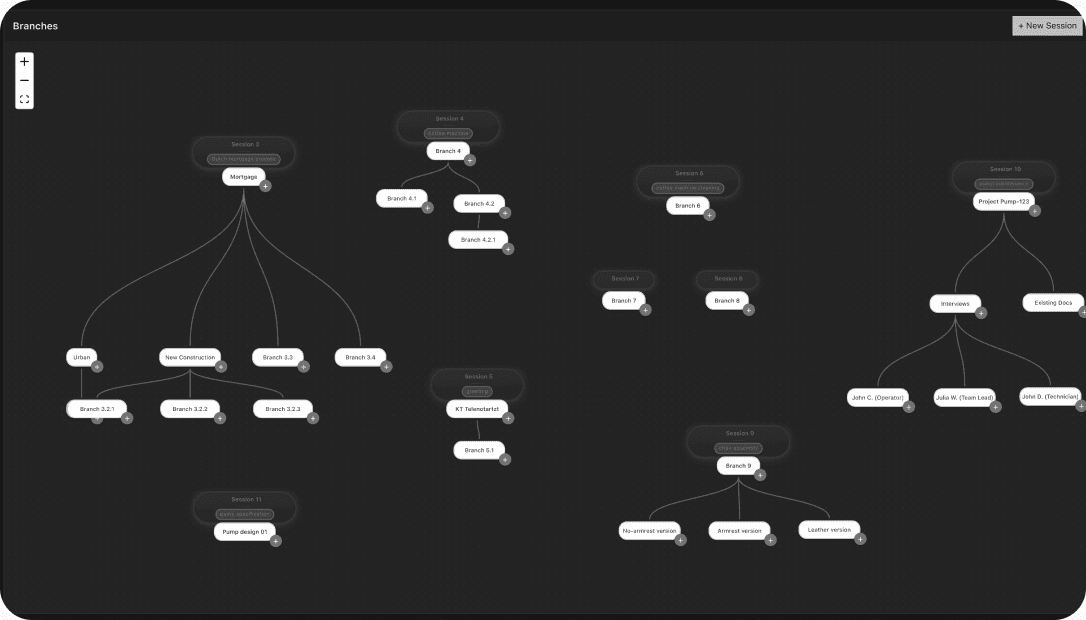
How might we redesign the branch view around this new role?
Turn branches into an editable knowledge graph
- Connect related procedures across branches
- Reorganize knowledge as structures evolve
- Extract knowledge into new branches when needed
- Surface related knowledge beyond the current hierarchy
How does captured knowledge enter this structure?
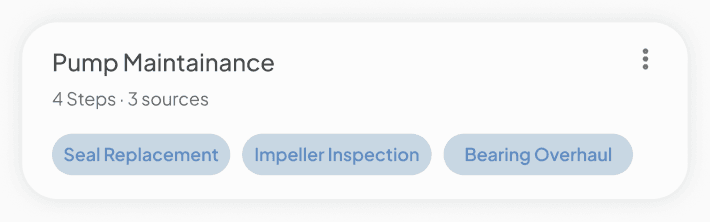
Use metadata for AI-assisted placement
Extended tagging to procedures for AI-assisted organization, while keeping users in control.

Validation
Stress-testing the concept before real-world validation
AI-assisted stress test
To check whether the redesigned flow still supported the original design goals, I ran two role-based AI walkthroughs using recorded prototype flows before real-world testing.
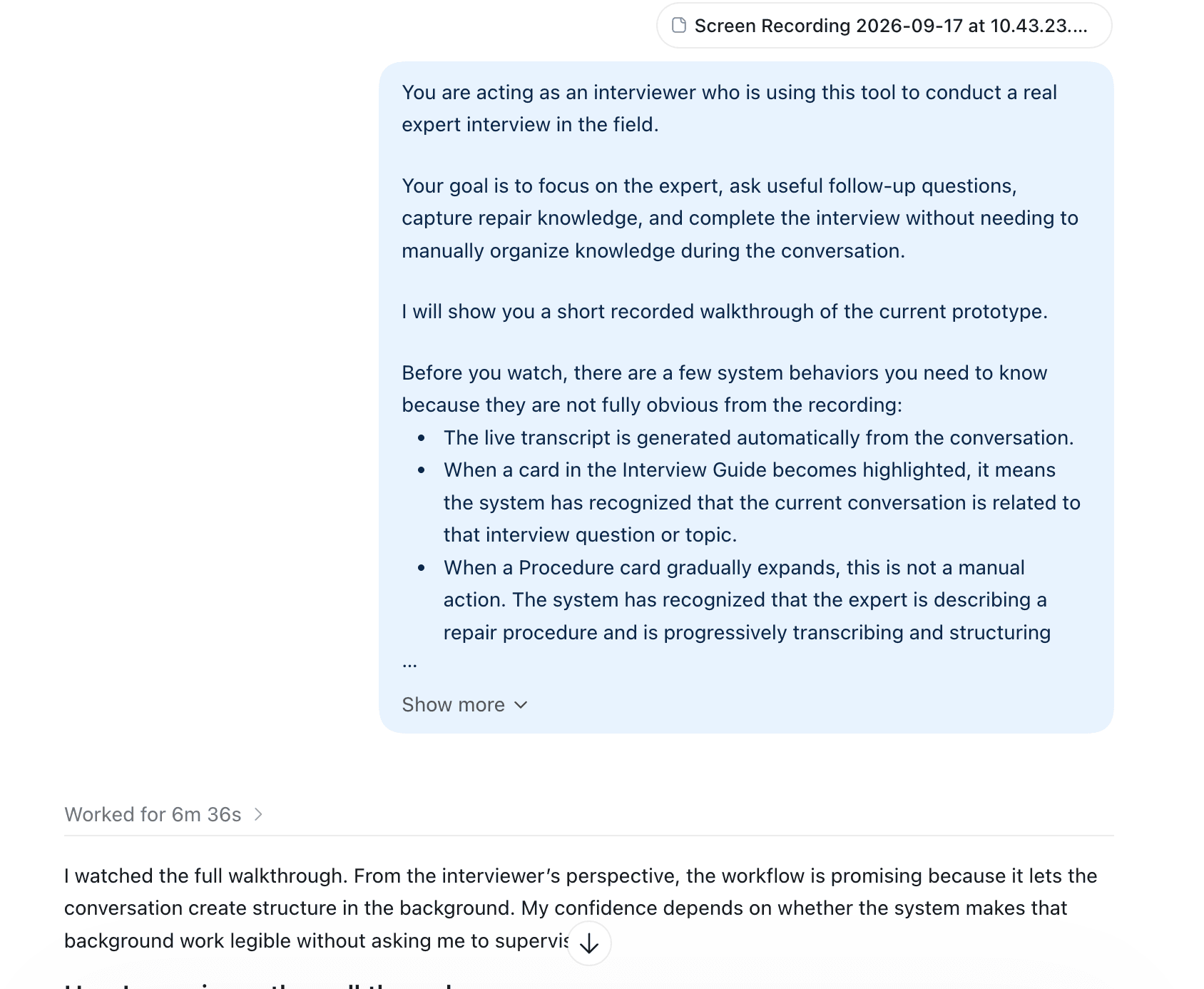
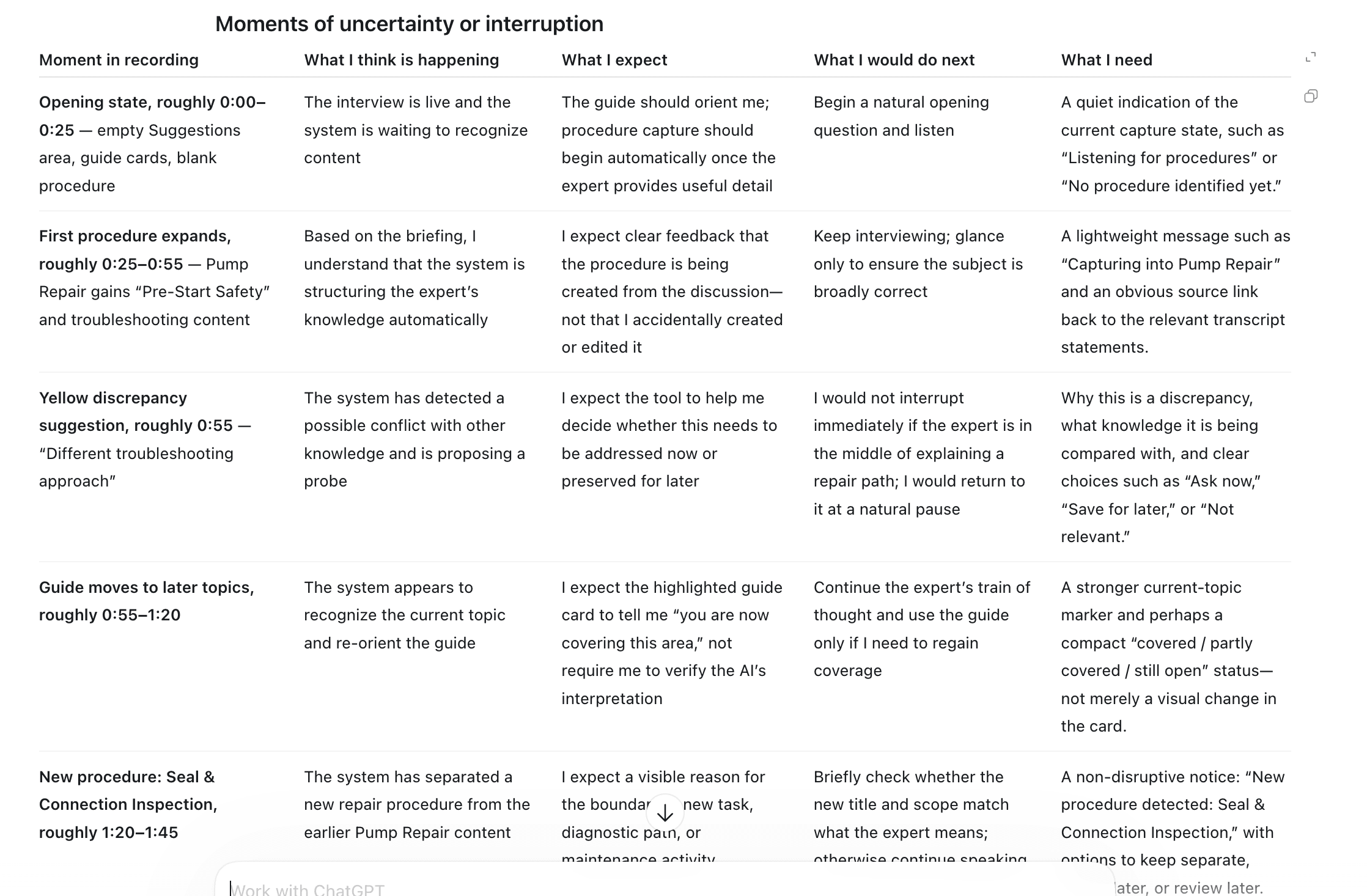
Interviewer persona
Can interviewers stay focused while AI supports deeper knowledge capture?
Potential strengths identified
- Guide kept the conversation flexible
- AI follow-ups surfaced deeper knowledge
- Procedure capture stayed in the background
Recommended next step
Make AI activity clearer and less attention-demanding.
Knowledge manager persona
Can captured knowledge be reorganized and reused without losing context?
Potential strengths identified
- Handoff from interview to graph was clear
- Relationships across procedures were easier to see
- AI-assisted refactoring supported reorganization
Recommended next step
Clarify relationships, explain AI-driven changes, and keep them reversible.
Lightweight usability validation
Testing the prototype with 5 peers to identify usability issues, unclear interactions, and moments of unnecessary cognitive load.
80%
found the interview flow easy to follow
100%
found the interview flow easy to follow
20%
felt AI suggestions could be less interruptive
If deployed with target users, how would I measure success?
Interview focus
Time spent with the expert vs. managing the interface
AI usefulness
Follow-up adoption and new knowledge surfaced
Knowledge quality
Correction rate and review effort before approval
Knowledge reuse
Procedures reused, connected, or reorganized later
AI Usage Overview
How AI supported my process
Research
AI-assisted desk research and synthetic expert simulation to test assumptions.
Design
AI-assisted UI style exploration and iteration.
Prototype
Figma MCP + Cursor for interactive prototyping.
Stress-test
Role-based AI walkthroughs to challenge workflows.
Reflection
What I contributed
Helped reframe an early interview demo into a focused knowledge-capture workflow.
Co-developed the separation between interviewing and knowledge organization.
Independently extended the concept into procedure handoff and an editable Knowledge Graph.
What I learned
Good product decisions are trade-offs. I learned to challenge workflows while working within technical and business constraints.
More AI needs more transparency. Automation works best when people can understand, verify, and reverse its actions.
Validation has limits. AI walkthroughs can stress-test logic, but real users are still needed to validate behavior and outcomes.
What I would validate next
Test with real interviewers and experts.
Measure interview focus, follow-up usefulness, correction effort, and knowledge reuse.
Validate the knowledge model against real client structures and governance.
Refine AI feedback, traceability, and reversibility.
